


Teruel · Aragón · Spain
Teruel: The Spanish City That Had to Prove It Exists
A guide to Teruel, Spain, with Mudéjar towers, the Escalinata del Óvalo, the Lovers of Teruel, local food, parking and practical tips.
Teruel was our last stop on the way home to Valencia, at the end of a longer loop through Aragón and Navarra that had taken in the Bardenas Reales desert, three days walking in the Aragonese Pyrenees and the waterfalls at Monasterio de Piedra. We had a couple of hours to give it before the final stretch of the drive, and it turned out to be a very good reason to get out of the car.
Teruel is the capital of the southernmost province of Aragón, the region that runs down the eastern side of Spain between Catalonia and Castilla - best known for the Pyrenees in its north, and for a great deal of empty, dry country in its south. Teruel sits in that southern half, and it is the least populated provincial capital in Spain. That combination produced something unusual: in the 1990s the city organised a protest movement called Teruel existe - “Teruel exists” - campaigning for better roads, railways and investment. The name was chosen in response to a long-running national joke that Teruel barely existed at all. It’s a city that has had to argue for its own existence, and it eventually took the argument all the way into the Spanish parliament.
We noticed the emptiness before we knew any of that. There were very few people on the streets, though we put it down to the heat of a July afternoon at the time. Only later did I realise that quiet is the city’s permanent condition rather than a quirk of the hour.
What we did notice straight away was the colour. Teruel is orange, that Terracota shade - the towers, the churches, the ordinary houses, all of it built in the same warm reddish brick, so the whole town has a single tone. That brick is the reason the city matters: it holds one of the greatest concentrations of Mudéjar architecture in Spain.
What Mudéjar means, briefly
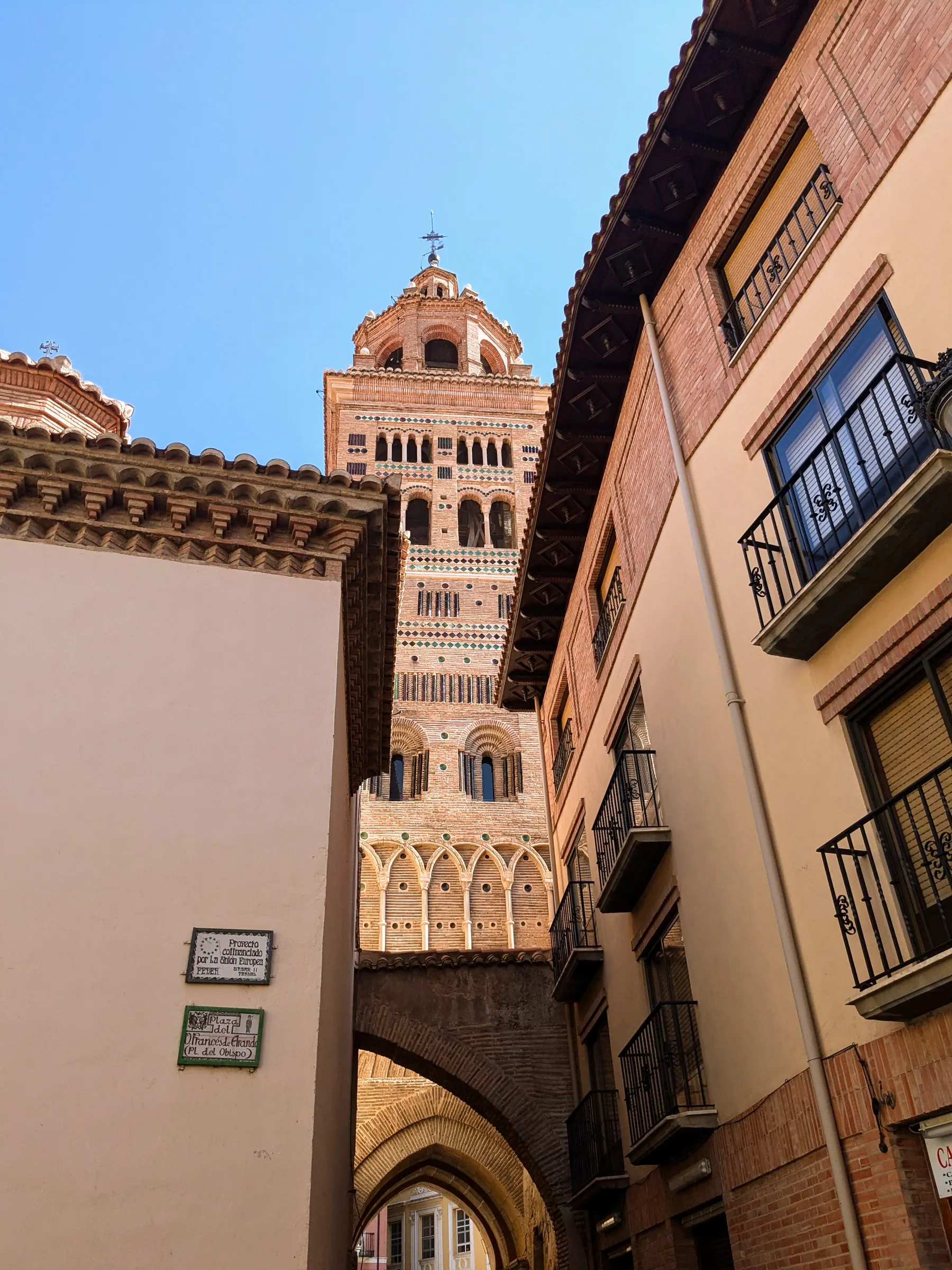
Mudéjar was the style produced by Muslim craftsmen who stayed in Spain after the Christian reconquest, working for Christian patrons. The result is buildings that are structurally Gothic but decorated with brickwork, glazed ceramic and geometric patterns from Islamic tradition - two cultures visible in the same wall.
The Escalinata del Óvalo
Next to train station, the first thing you meet is the Escalinata del Óvalo - a monumental staircase built in 1920-21 to connect the railway station with the city centre above it. Coming from the other direction, as we did, you have to walk down to it, which is worth doing.
It stands slightly apart from the main run of monuments in the old town, so it would be easy to skip, and it’s absolutely worth the walk down to see it properly rather than glimpsing it from above. It was designed to make arriving in Teruel feel like an occasion, and it still does that.
This is actually my favorite place in Teruel.
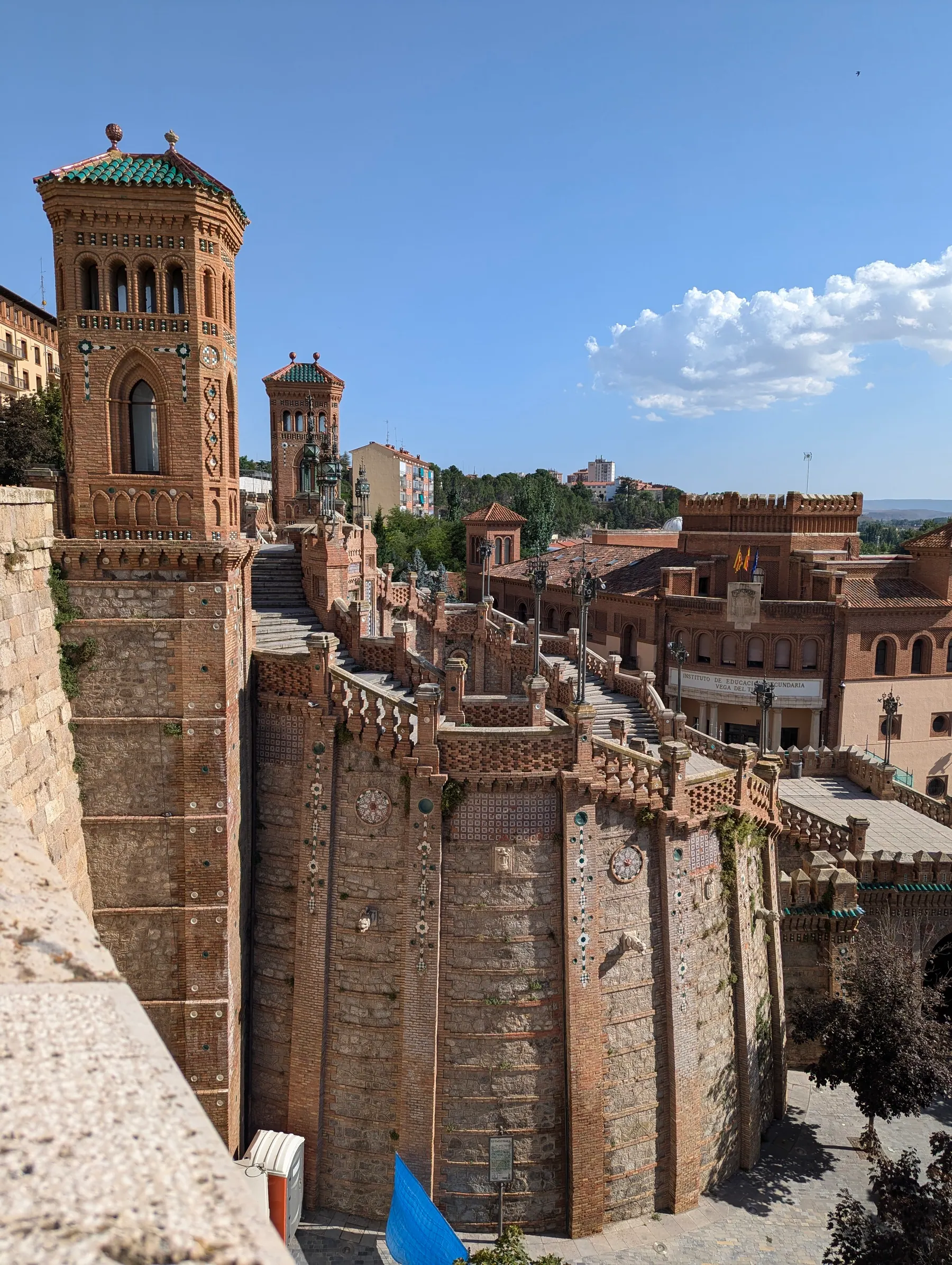
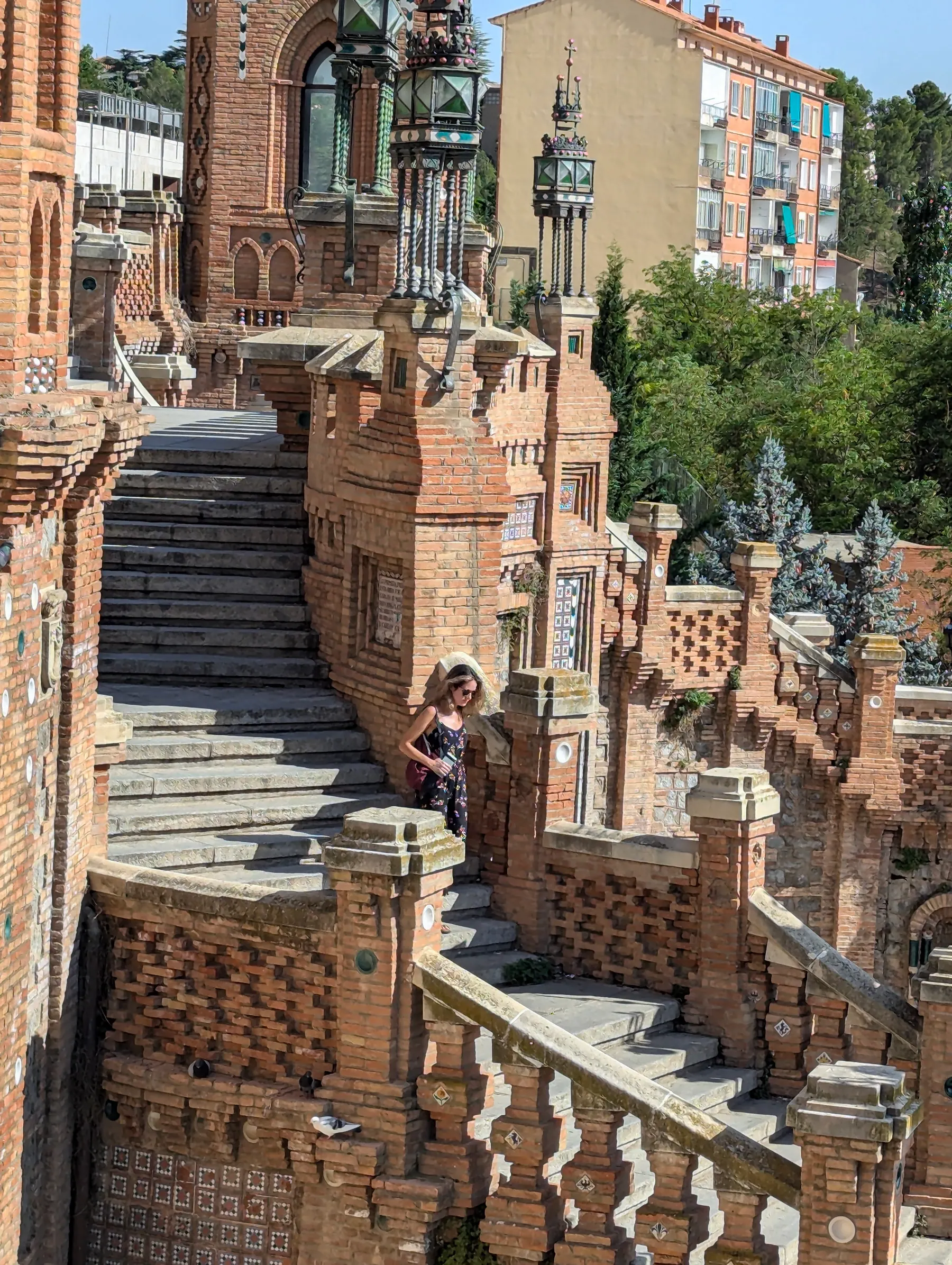
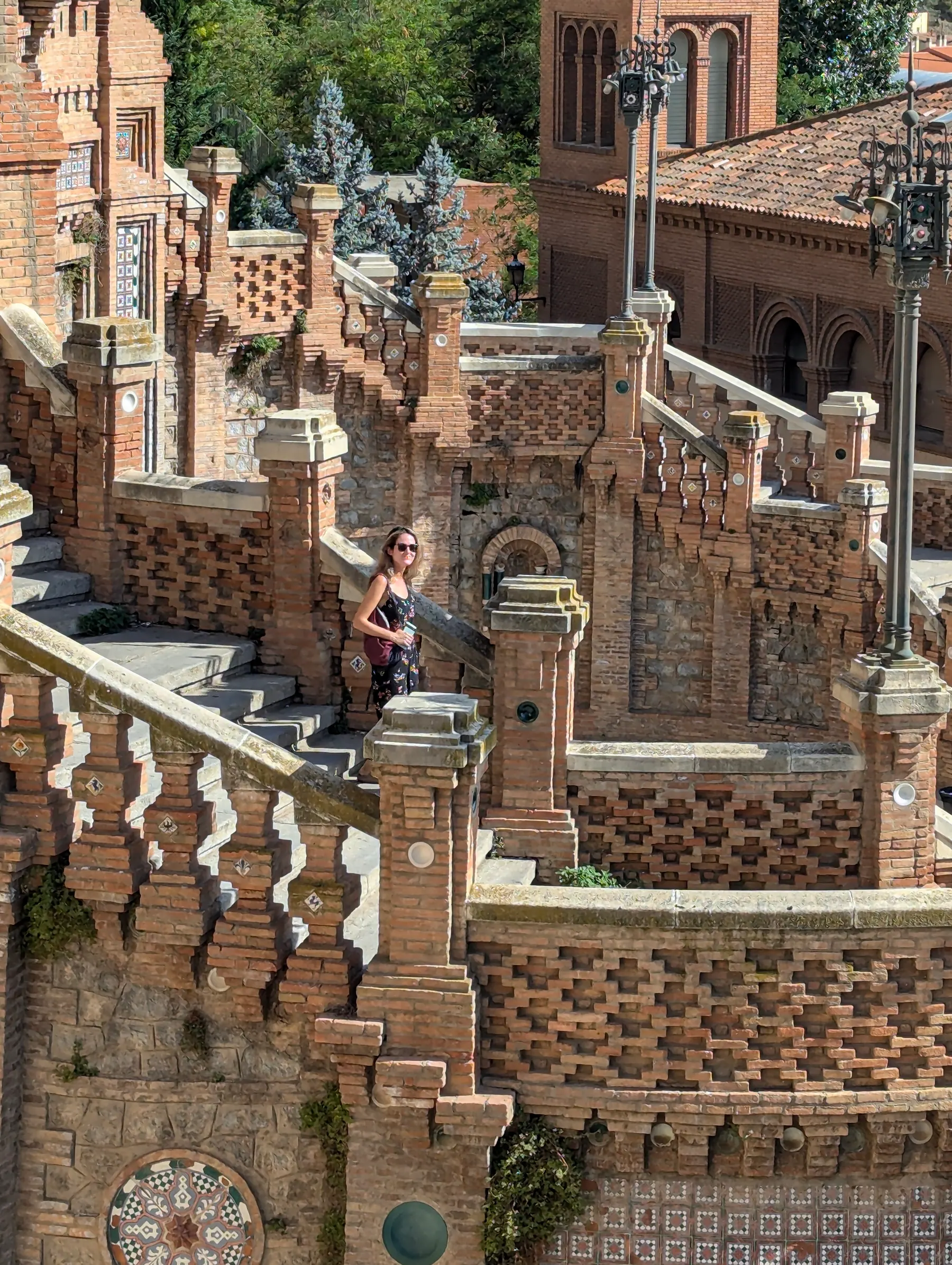
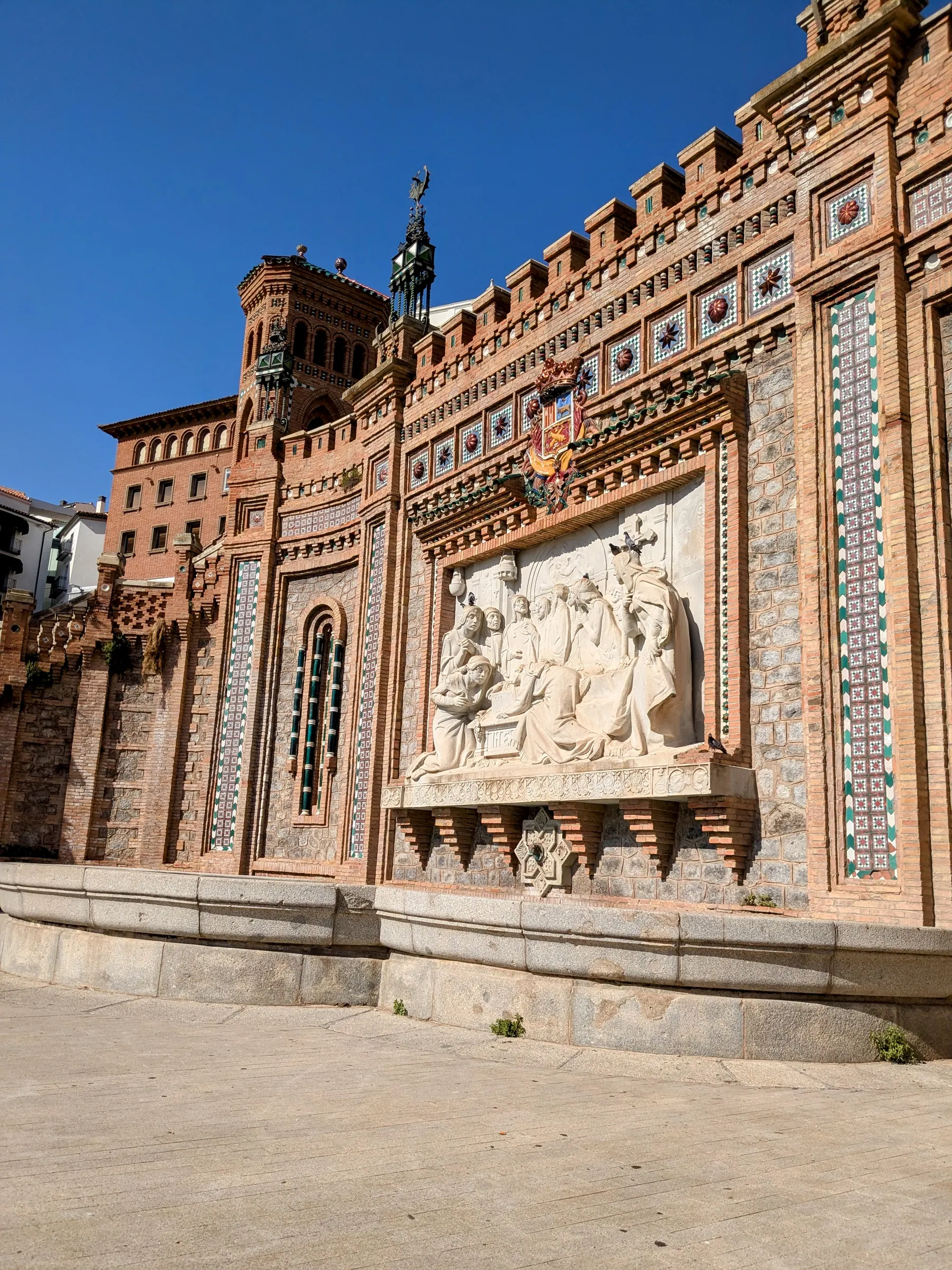
It’s Neo-Mudéjar - the 19th and 20th-century revival of the style, built by architects who were consciously copying the medieval towers rather than working in a living tradition. This one went up six centuries after the towers it imitates, in brick and glazed tile with a relief of the Lovers at its base, and it’s considered the key work of Neo-Mudéjar in the city. Knowing it’s an imitation doesn’t spoil it at all.
What I liked most was the detail. Every part of it is worked - the brickwork, the tiles, the lamps, the small towers along the sides - and it doesn’t feel like a staircase with decoration added. It feels like a piece of art that happens to also get you up the hill.
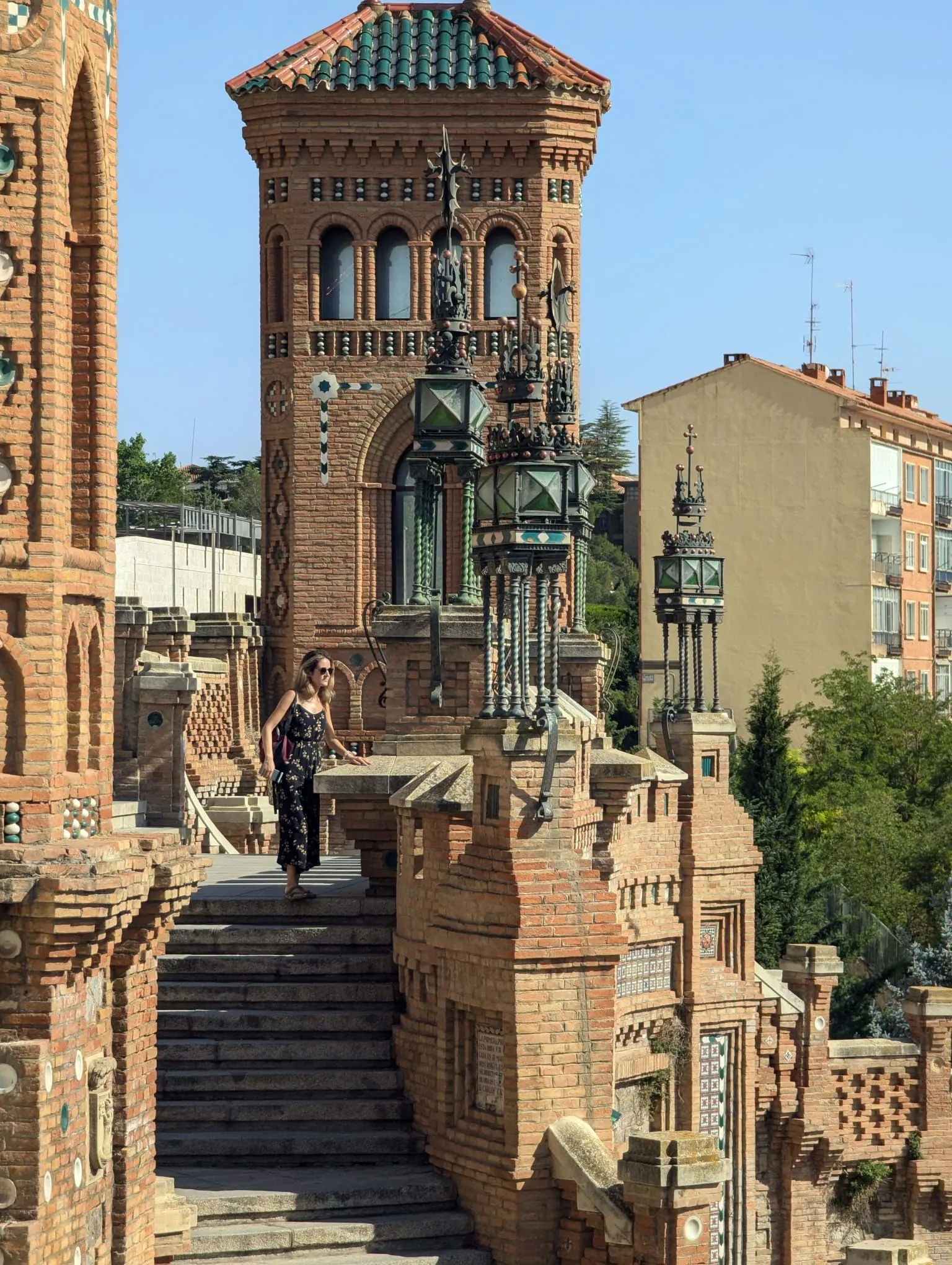
If you don’t want to climb the 140 steps, there’s a second way up beside it. A tall opening was cut into the retaining wall below the avenue - shaped like a gate in a city wall, and narrowing as you go in - leading to a tunnel and a pair of lifts that carry you the seventeen metres up to the Paseo del Óvalo. It was added in the early 2000s by the British architect, and it’s a strange, quiet piece of modern architecture to find at the foot of a 1920s staircase.
The towers and cathedral
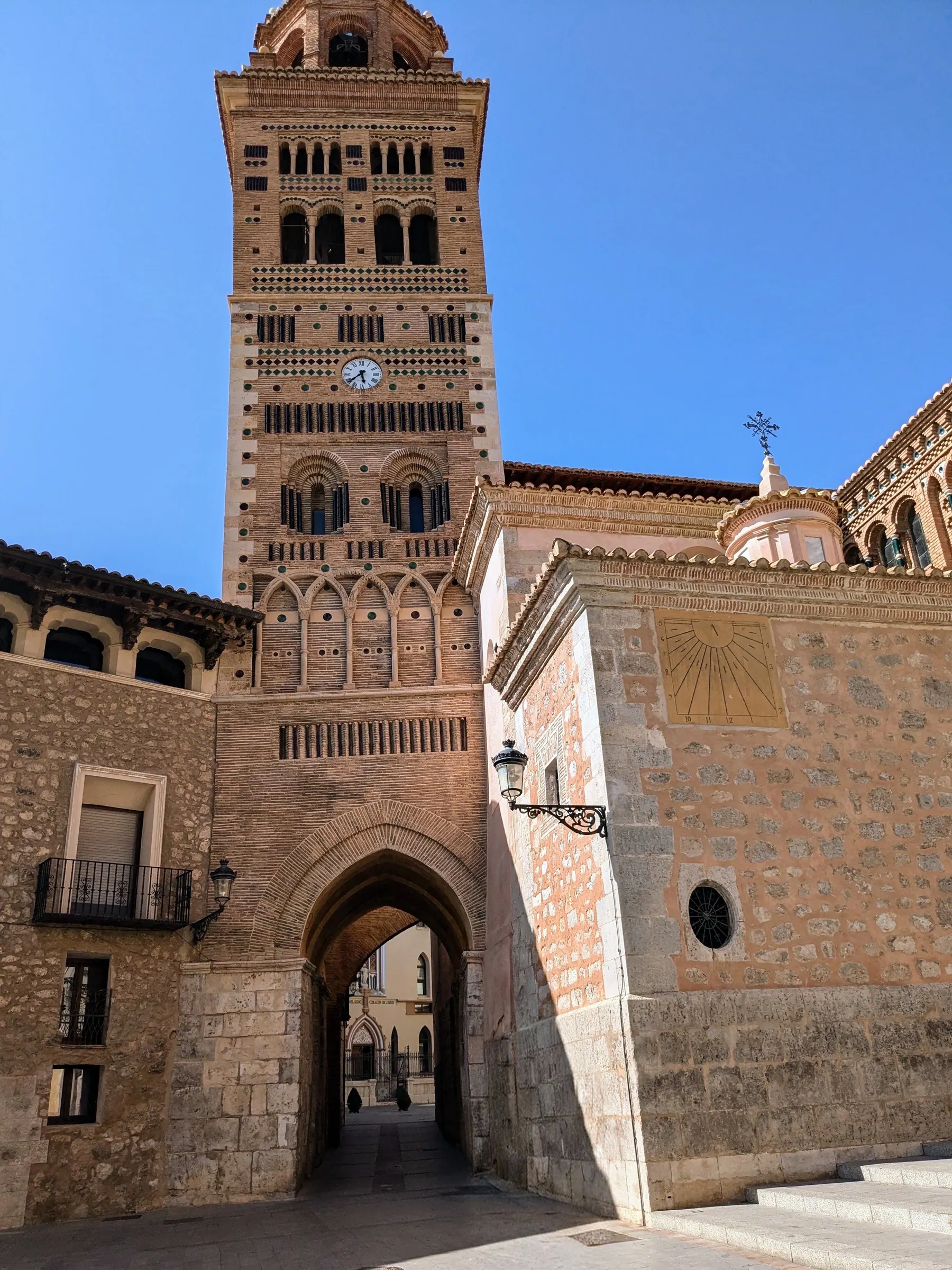
The Cathedral of Santa María de Mediavilla sits in the middle of the old town with its Mudéjar tower standing right beside it, and the coloured tiles on its domes are the brightest thing on the skyline. The reason to go in is the ceiling.
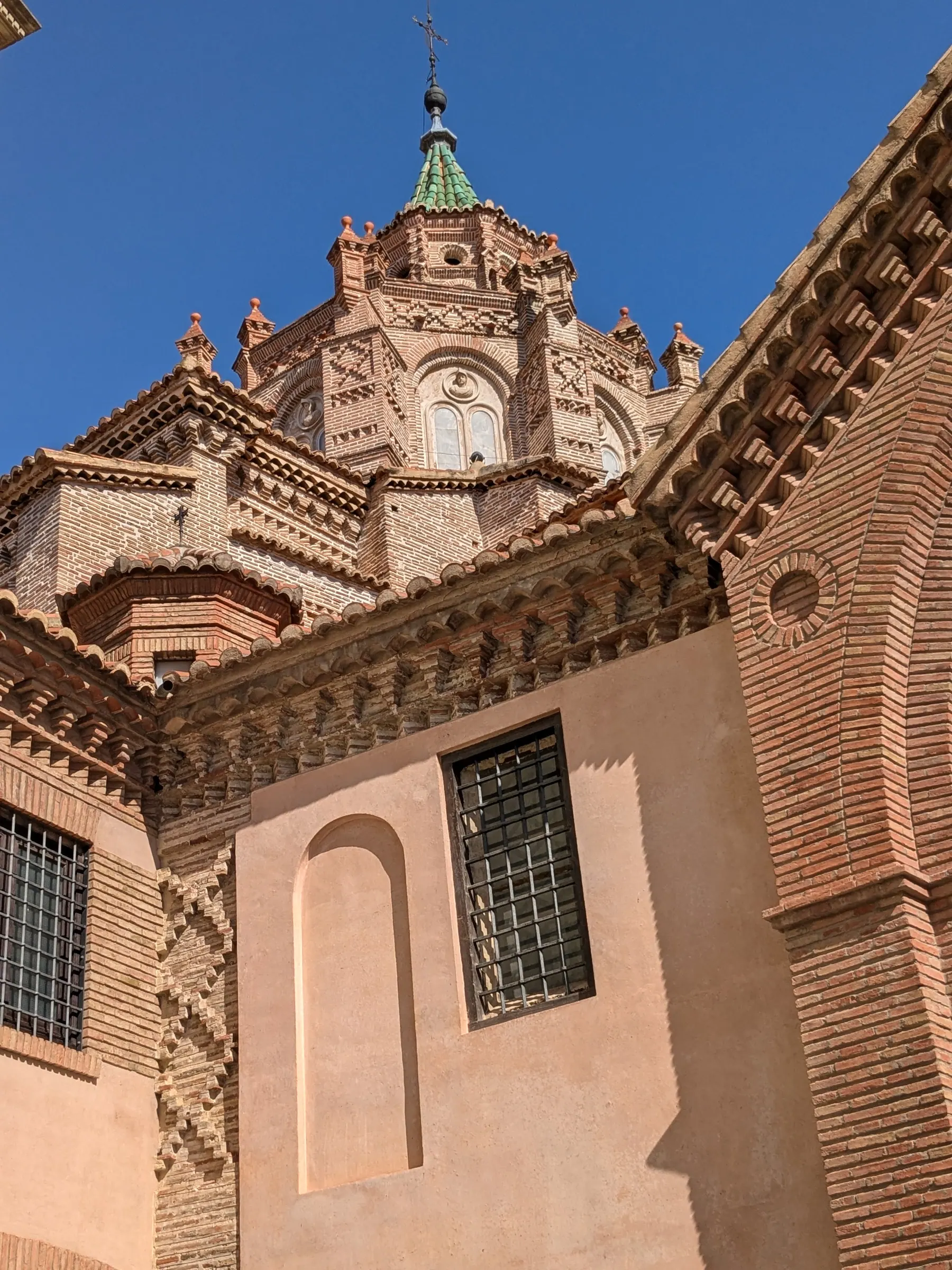
It’s a 14th-century painted wooden ceiling, and it’s been called the Sistine Chapel of Mudéjar art - not for its scale but for how much survives, and how much detail is in it. Entry is a few euros, and it’s the interior most worth your time if you only choose one.
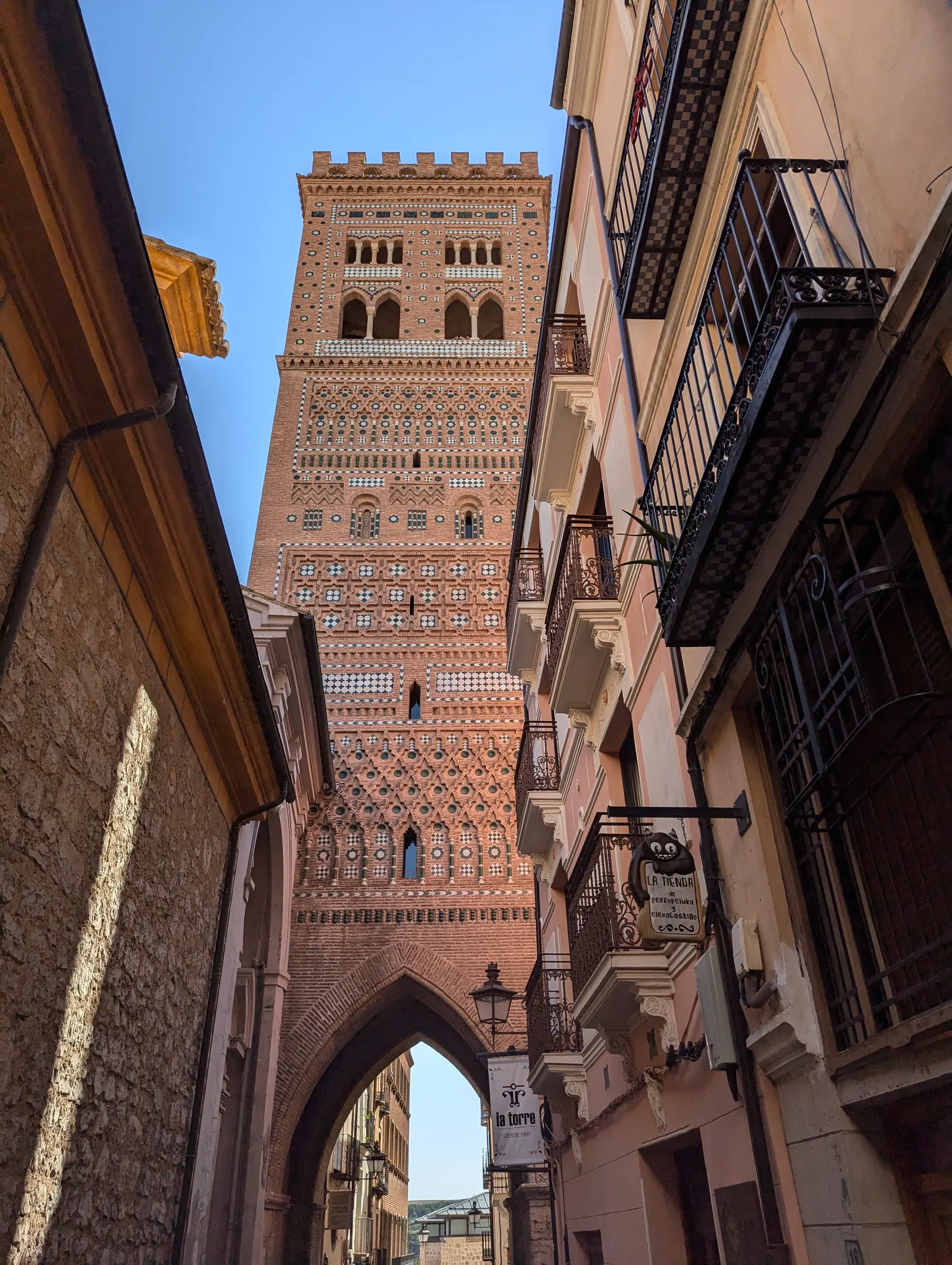
There are four Mudéjar towers in the city - San Martín, El Salvador, San Pedro and the tower of the cathedral. They’re built of brick and inlaid with glazed ceramic in green and white, and they don’t look like church towers anywhere else in Spain.
Two things make them unusual. The first is that most of them are pierced at the base by an archway you can walk straight through, so the tower doubles as a gate between two streets. That’s why you keep finding yourself passing underneath them rather than around them.
The second is how the later ones are built. San Martín and El Salvador, both from the 14th century, are constructed as two towers, one inside the other, with the staircase running up the gap between them - a form borrowed from North African minarets rather than from anything Christian. San Pedro and the cathedral tower are a century older and built differently, which you can see if you go up more than one.
El Salvador is the one to go up if you only pick one. It’s 40 metres tall, probably the most heavily decorated of the four, and 119 steps take you up through three floors - now an interpretation centre explaining the Mudéjar style - to the bell chamber and a view over the whole city.
San Martín is very similar and can also be climbed, and the San Pedro tower is included in the Lovers ticket.
Plaza del Torico
The main square, and the place to stop. It’s named after the torico, a small bronze bull standing on a tall column in the middle of it.
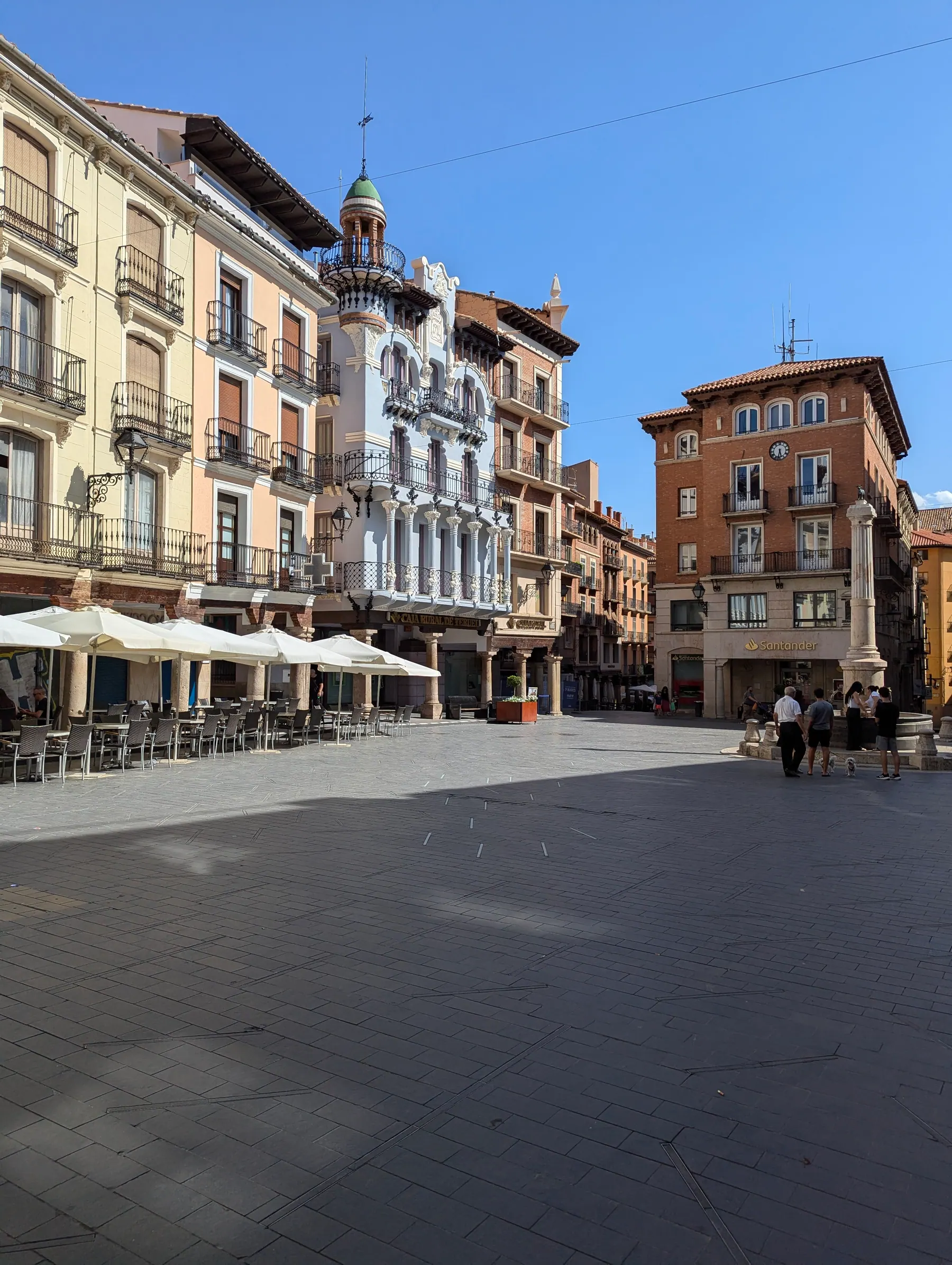
We sat down here for a coffee. It’s ringed by cafés and by the prettiest façades in the old town - several of them modernista (Spanish Art Nouveau), all curved balconies and ironwork, which is not what you expect after a morning of medieval brick.
The Lovers of Teruel
Every Spanish city has a legend. Teruel’s is unusually specific.
In the 13th century Diego de Marcilla loved Isabel de Segura, but he was poor, so her father gave him five years to make his fortune. He came back on the last day and found her married. He asked for a kiss, she refused, and he died on the spot. At his funeral she kissed him and died too, and they were buried together.
You can visit their tombs in the Mausoleo de los Amantes, beside the church of San Pedro.
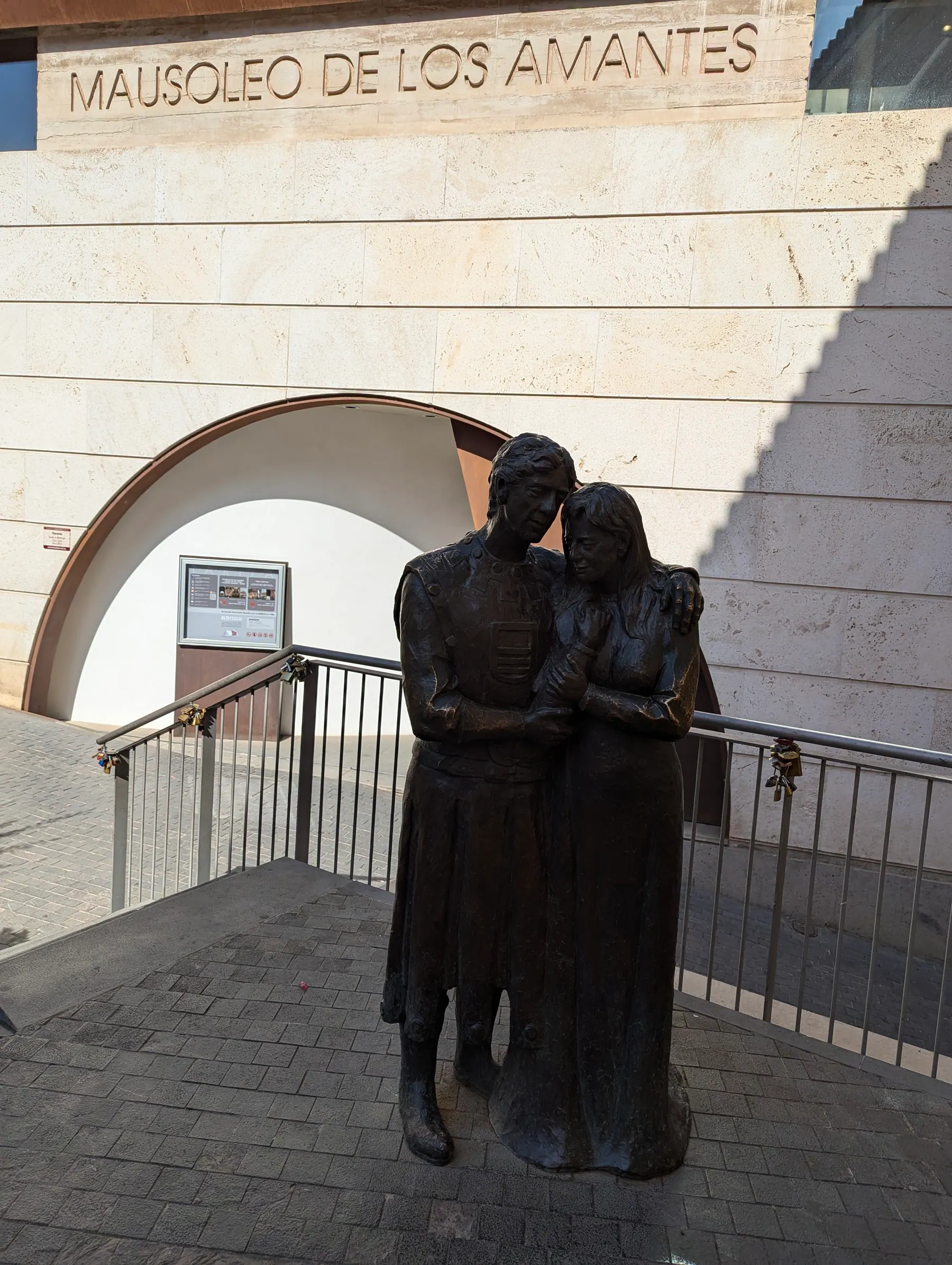
The ticket covers the mausoleum along with the church of San Pedro, its cloister and gardens, and the tower - around €9, or a euro more to climb the tower. Check current prices before you go.
The San Julián lift, and where to park
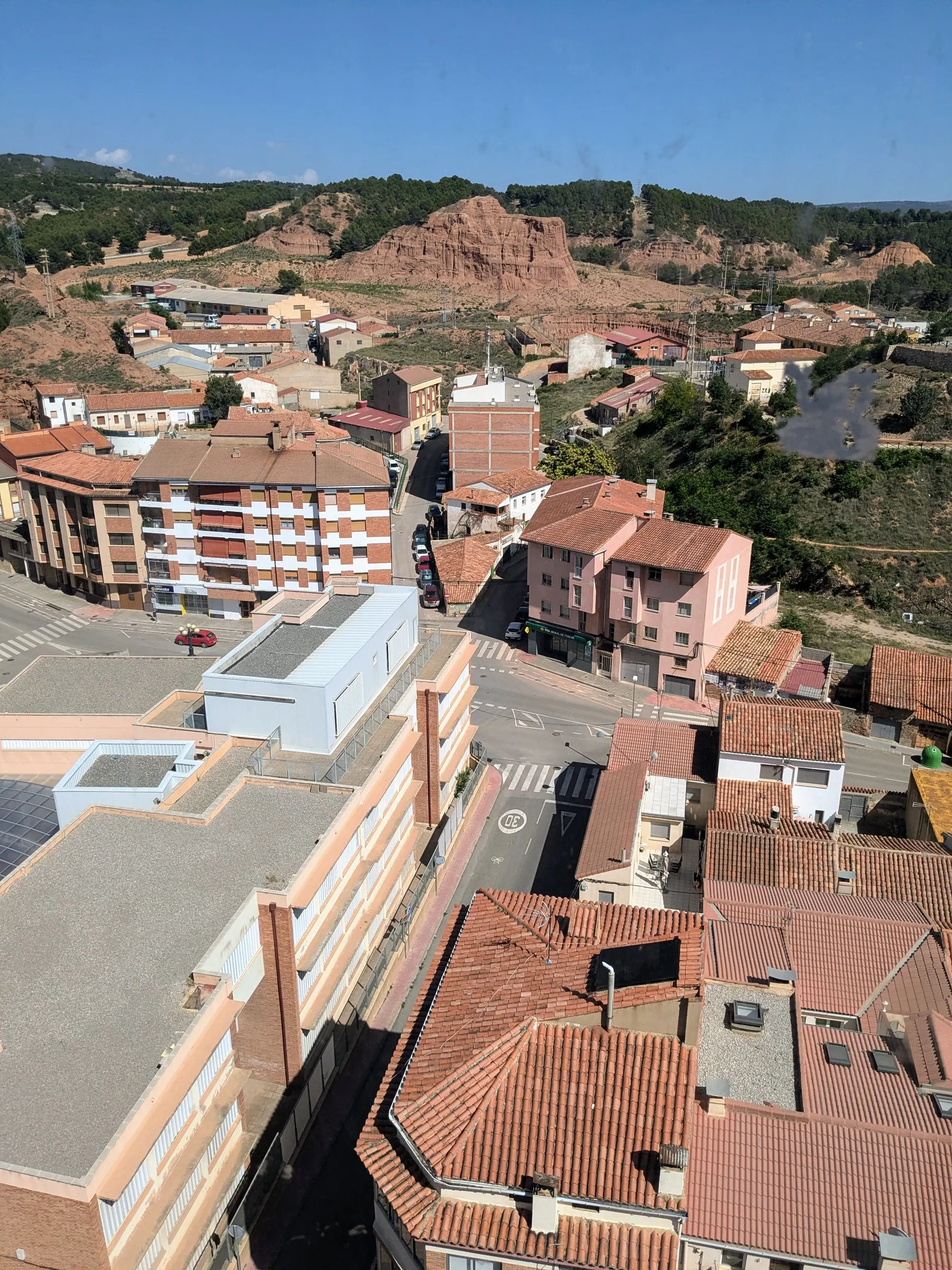
This is a different lift from the one beside the Escalinata, on the other side of the old town. Teruel sits on a hill and has solved the climb twice: the Escalinata lifts bring you up from the station, and the Ascensor de San Julián brings you up from the San Julián neighbourhood, forty metres below the historic centre, in a lift built inside a tower.
We parked in the underground car park right next to it and rode up, which puts you in the old town in a couple of minutes. It’s worth doing for its own sake too: the tower is clad in rust-coloured steel meant to echo the Mudéjar brickwork, and a glass walkway juts out at the top as a viewing platform, looking over the rooftops of San Julián and the pale clay hills that surround the city. It’s a bit outside the monumental part of town and easy to miss.
What else is nearby
Dinópolis is on the edge of the city, and it’s the one thing here that has nothing to do with Mudéjar brick. Teruel province is one of the richest palaeontological areas in Europe, and the park is built around that - a museum of real fossils alongside a family attraction. Its centrepiece is the Turiasaurus riodevensis, found in the province and one of the largest dinosaurs ever discovered in Europe. Not our sort of stop, but if you’re travelling with children it’s the obvious one.
Albarracín is about 40 kilometres west, and it’s the reason a lot of people come to this province at all. It’s regularly named one of the most beautiful villages in Spain: a walled hill town of pink-red houses stacked above a river gorge, with a castle and a defensive tower on the ridge above it. I went separately, in winter, for two days, and it deserves that rather than an afternoon. If you’re deciding between the two and you have time for only one, Albarracín is the more spectacular. Teruel is the more surprising.
One thing to eat
If you stop for lunch rather than just a coffee, the thing to order is jamón de Teruel. It’s cured up here in the cold, dry mountain air, and it was the first Spanish ham to be given a protected designation of origin. You’ll find it on every menu in the city, and it’s the one local product Teruel is known for beyond its own province.
Getting there, and when to go
Teruel sits about 145 kilometres inland from Valencia, roughly an hour and 45 minutes by car, which makes it an easy stop on any drive north (if you are planning travels around the region, check out our full guide to the best day trips from Valencia).
There’s also a train, although the limited service shows how isolated Teruel remains: Renfe runs three a day from Valencia Nord, taking about two and a half hours, and four a day from Zaragoza, the fastest of which is under an hour and a half. There is no high-speed line. The station sits below the old town, at the foot of the Escalinata, and everything in the centre is walkable from there.
We went in July and it was very hot. The city stands at over 900 metres, so it’s known for its cold winters, but in midsummer the old town bakes.
Is it worth stopping?
Yes, and it works at whatever pace you have. Everything is walkable and close together - once you’re up at the top there’s no more climbing to do, so you can ride up the lift, sit in Plaza del Torico, walk between the towers and go down to the staircase without rushing any of it. Give it a couple of hours and you can see the main sights and step inside one or two of them; give it a full day and you can explore the cathedral and mausoleum without rushing, with time left for a plate of ham.
With two hours we stayed outside everything, so the cathedral ceiling and the mausoleum are what I’d go back for, along with the Renaissance aqueduct and the old walls on the far side of town. But there’s something fitting about arriving in the least-visited capital in Spain as an afterthought, and leaving thinking you were wrong about it.
FAQs
Is Teruel worth visiting?
Yes. Teruel is compact, easy to walk and unusually rich in Mudéjar architecture, with the Escalinata del Óvalo, cathedral ceiling and Lovers of Teruel among its highlights.
How long do you need in Teruel?
Two or three hours is enough to see the main squares, towers and Escalinata from the outside. Allow a full day if you want to visit the cathedral, mausoleum and more than one tower without rushing.
Can you explore Teruel without a car?
Yes. The historic centre is compact and walkable from the train station. The Escalinata lifts and the San Julián lift make the climb into the old town easier.
Read next
More posts for this trip mood
 Europe
 Aragón, Spain
Monasterio de Piedra: A Fairytale Waterfall Park to Escape the Summer Heat
A hidden waterfall detour that feels like a small paradise in dry Aragón.
A summer visit to Monasterio de Piedra in Aragón, Spain, with waterfalls, caves, monastery history, practical tips and why it is worth the detour from Zaragoza.
 Europe
 Aragón, Spain
The impressive Aragonese Pyrenees in Summer: Ordesa, Valle de Otal and the Benasque Valley
Ordesa is spectacular and unmissable, but Valle de Otal is the quieter memory.
A personal three-day summer trip through the Aragonese Pyrenees, with Ordesa, Valle de Otal, the Benasque Valley and practical hiking advice.
 Europe
 Valencian Community, Spain
Things to See and Do in Valencia: What's Actually Worth Seeing
A firsthand local guide to Valencia, Spain. From historic El Carmen alleys and biking the Turia riverbed to the City of Arts and Sciences, beach days, and real paella.